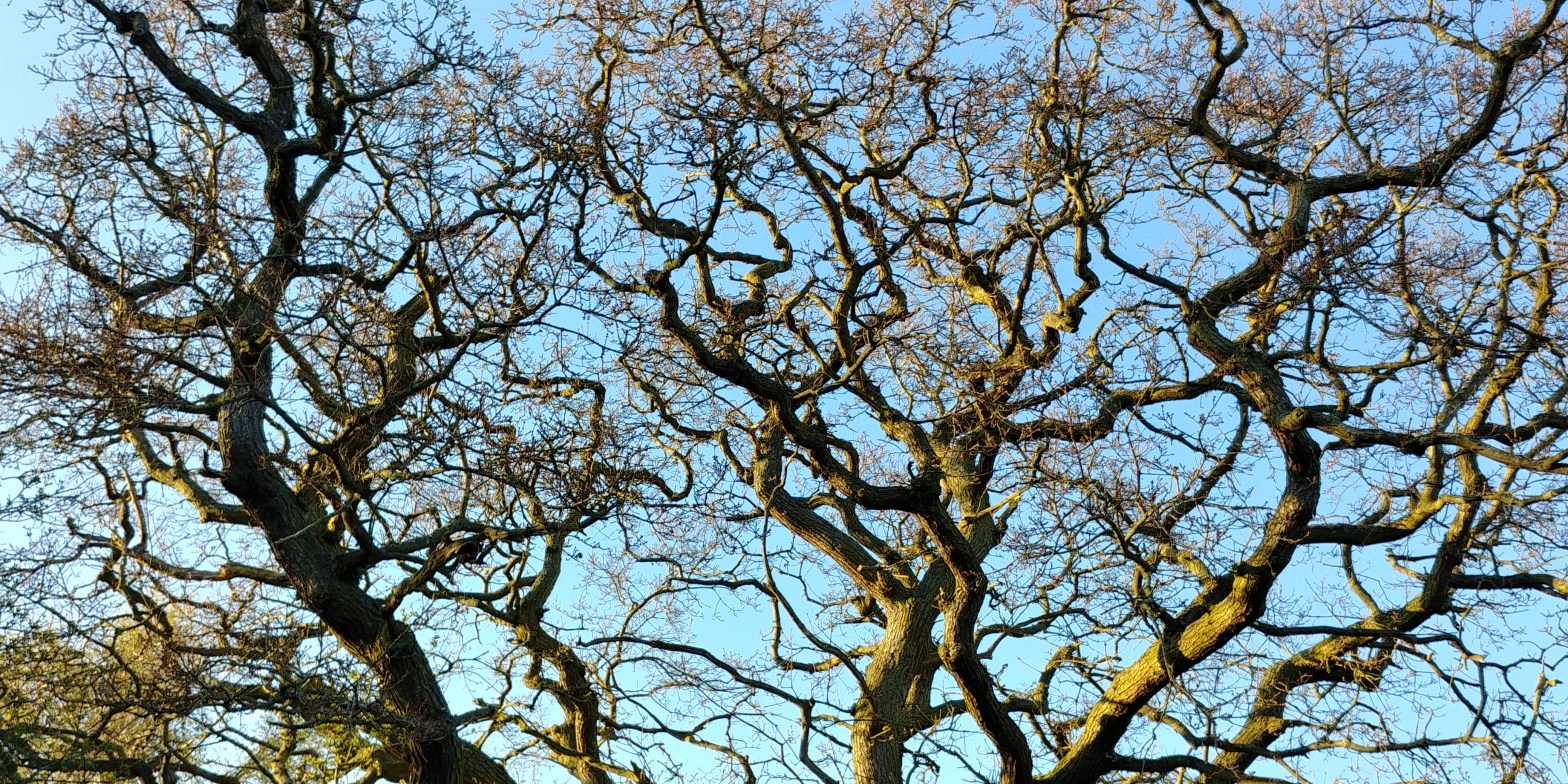
It’s a short walk past the deserted football fields where black-headed gulls search out washed up worms and scream their strangled yelps. At the gateway is an old oak, knobbly-elbowed, bare branches stretching across the path. I reach my arms around it, smelling the musty ridged bark and pressing my fingers into its fissures. Alone, I embrace about a half of the tree’s girth. Its history is of agriculture, our disappearing wildness, the urbanisation of this land.
The gate has been wedged open. Last year, multi-coloured messages of hope were chalked here. It’s a shared surface we all avoid touching.
This walk is one I have done many times in the last year, either striding along the paths that follow the edges of the wood just inside the shelter of the trees; or emerging from the other side into an enclosed green lane that opens onto longer walks. It has been my breath of fresh air, lockdown exercise yard, a quick escape from the restrictions of indoor life. At other times, I have gone to ground, winding off the perimeter paths to hold myself in just a snatch of wildness. I have immersed myself in the world of leaf litter, scented shelves of fungi, the scuttle and scatter of invertebrates.
Putnoe Wood sits in the slightest of curves on the hillside, a rectangular tamed snippet of the wildwood known by the Anglo-Saxon settler Putta and his family. I like to imagine them taking timber and brushwood for building, tools and firewood. Maybe their hairy pigs roamed here, crunching on the abundant acorns and rootling for toadstools.
This wood is my restoration. It is reliably constant, absorbing and changeable; always there, always giving something new.
Today, the scrunchy, infinite shades of brown at ground level have been replaced by a new garden. Vivid, refreshing green extends under the branched archways, a jumble of shining pointed bluebell leaves, mosses flowing over rotten logs, the dodgy-looking spotted shields of wild arum and the understated flowers of dog’s mercury. Bird song is belting out the beginning of the now unstoppable cascade of spring. Sawing great tits, drumming woodpeckers and whooping stock doves shout into the chilly air. Violets and primroses are the first flowers to emerge into the light that filters through wintered and empty craggy black twigs. A solitary carrion crow scrapes together pine needles for nest-building, watchful when I stop nearby.
The nameless straightened, steep-banked stream riffles gently, clear water over sifted gravel, neatly marking the boundary between wood and golf course. The ghosts of meandering curves remain as depressions in the woodland floor. The water comes and goes, but now mud-laden pools reveal another layer of history. Compacted pathways, dimpled with deer slots, splash through the puddles and slither down the stream banks. Deer have replaced the scavenging livestock of Domesday.
There’s a shrivelled, disembodied toffee-brown ear at my feet, a jelly ear fungus. Maybe Putta’s pigs would have fought over it, maybe they would have forged their own pathways through the undergrowth. The wood has done its magic and I return home revived. Every visit forms another fragment of my joint history with this place.
 Mudwriter