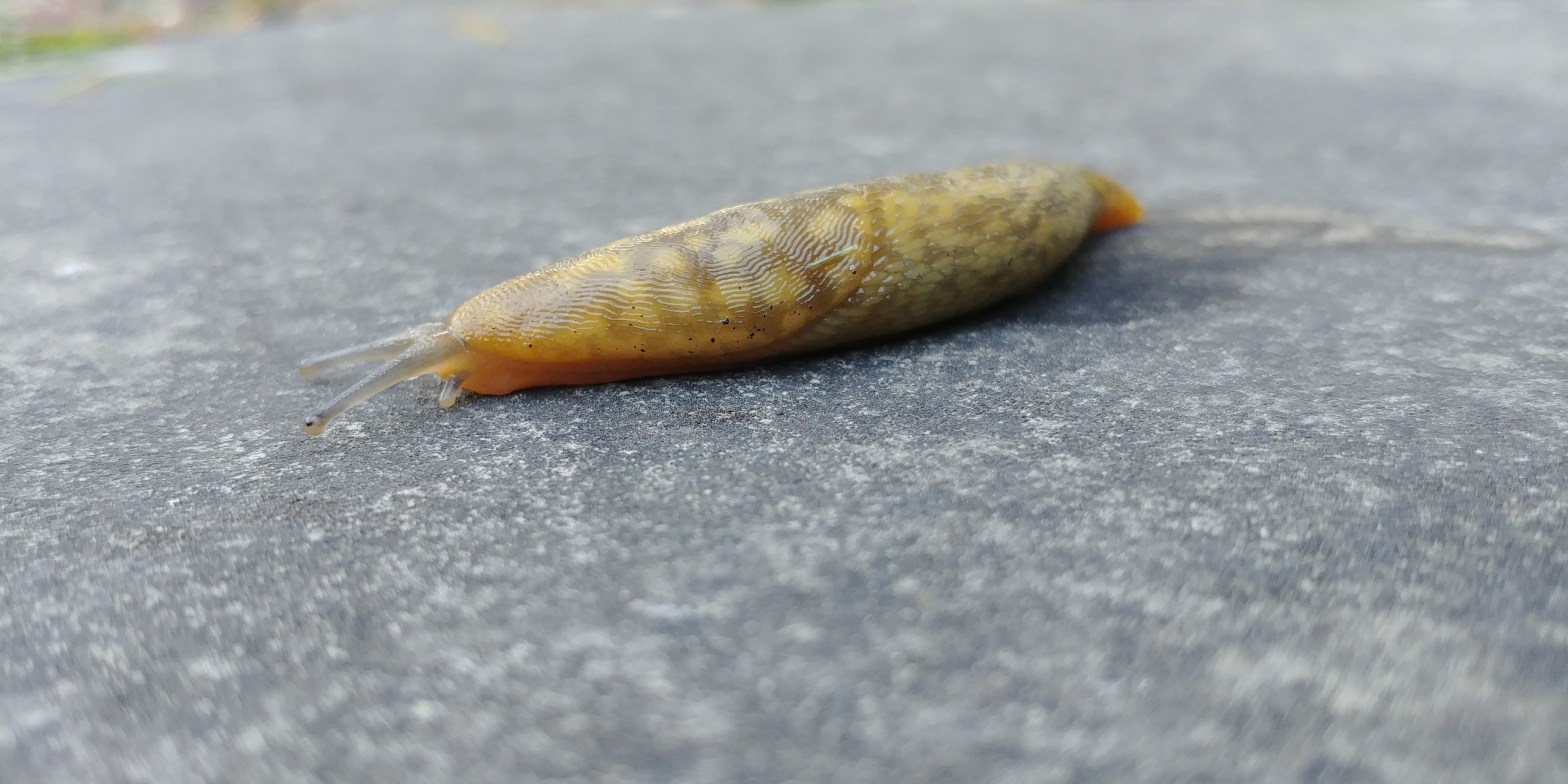
I always feel a little self-conscious as I turn off the well-worn path around the four sides of the wood, I scuffle furtively through leaf litter, crouching down to examine fungi or pick apart a rotting log to see what might be hidden inside their damp, crumbling innards. This was how I found four small fat slugs each curled up inside an oval hole like dark, slimy peas in a pod. I deployed a twig to ease them out into a pre-prepared yogurt pot and took them home for closer examination.
The first slug I picked out was the most vividly marked. The main body was striped with black and brown, something like the colour of milky coffee. The patterning at the head end was more blotchy than stripy, but in the same colours. Underneath, its muscular foot was milky white.
Slugs are not many people’s favourite creatures. They are slimy, make an awful mess if you have the misfortune to tread on one and have taken the blame for many failed gardening projects. But only a few are partial to garden plants and they are amongst the army of unloved organisms that break down dead plant material to help create new soil.
I started to work through the features necessary to identify which species of slug this was. The colours and patterning can help, but there is a lot of variation, so I needed to look more closely. First, I checked for the position of the breathing pore. Being closely related to snails, slugs have a shell, but it is hidden under a flap of skin, the mantle, making it look a bit as if it has a saddle on its back. On the animal’s right, emerging from under the mantle, is the breathing pore or pneumostome, and it may be nearer the front or back of the mantle, depending on the species.
I looked at the back and tail next. Although the skin looked bumpy, the lumps (or tubercles) were quite small. Then I checked whether the slug had a ridge along its back or tail. It’s not an easy feature to see but, with some doubt, I concluded that this keel was only to be found at the end of the tail.
Although you might expect a slug’s anus to be at the end of the tail, in fact it is closer to the head: a by-product of the evolution of slugs from snails. The slimiest of slugs have an opening at the end of the tail which produces slime but there wasn’t one in the animal I was examining.
Most slugs will withdraw their tentacles when you pick them up, but they will often re-emerge and start exploring surprisingly quickly. Take your eyes off a slug for a minute or two and you might discover it sprinting across the dining room table when you come back to it. This specimen was not such an active one. It did, eventually, partly pop out one chocolate-brown antenna, the eye at the end taking a wary look before withdrawing again.
The collection of features drew me to the conclusion that this was probably a Leopard Slug, but at a relatively small 3cm, it was almost certainly a juvenile, nowhere near the 10-15cm body-length of an adult.
As a newcomer to slug identification I must accept that sometimes I will not be able to reach a positive identification. This proved to be the case for my next three slugs. They looked different in several ways, but nothing brought me to a firm conclusion. But I marvelled at their strangeness: the deep pore in the side of the body like a whale’s breathing hole and the antennae with eyes in their ends, extending and contracting as the slugs explored their new yogurt-pot world.
 Mudwriter