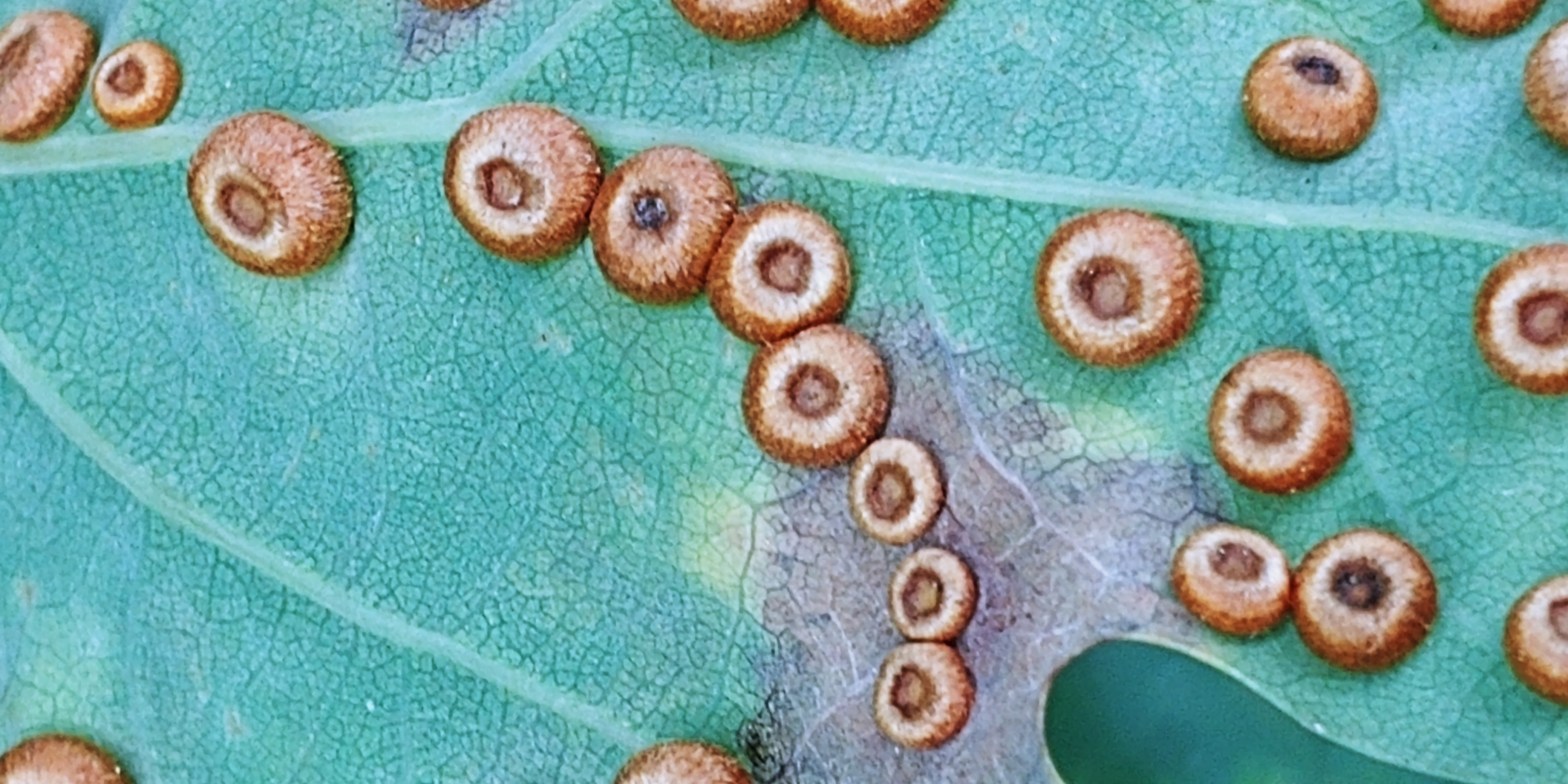
It was a typically Atlantic autumnal day of warm blustering wind. This is the best time of year to stare up through the canopy, enjoying the stained-glass effects of reds, oranges and yellows. So, stare up is what I did, neck creaking at right angles to my spine. Staring up at a sky that couldn’t decide whether to be blue or grey, I could see the footprints of aliens dotted through the leaves. I wanted to look more closely but years of hedge trimming, or perhaps the browsing of deer, meant that the leaves were just beyond what I could comfortably see. Pushing gently upwards I picked off a leaf to bring home, stowing it carefully in a pocket for later examination. More treasured leaves joined that first one and every so often my fingers met them again, brushing against their flaking surfaces and edges.
The oak leaf galls were like dwarf flying saucers, rough to the touch and only loosely attached. When I scrutinised them more closely, peering one-eyed through a hand-lens, I saw red hairs erupting from their surface. It was easy to pick one off and see the tiny dimple in the creamy white-chocolate underside where it was pinned to the leaf. The invader in this case was a deep-black hunch-backed wasp whose larvae trick the plant into growing a space pod, in which they will stowaway for winter in the leaf litter.
A hand-shaped field-maple leaf was peppered with an angry rash of minute red pustules, each no bigger than a single grass seed. Hairy grey craters on the underside of the leaf were the exit holes. From here, the arched, eight-legged mite larvae had crawled down to the tree trunk and concealed themselves in cracks in the bark.
My last leaf came from a willow and was contorted by two large oval-shaped blisters. They were brittle, snapping open when I bent them. A pale pregnant bulge, flushed with red, was pock-marked with blackened holes and the upper side of the gall had been ruptured. The robotic larval eating-machine had consumed the inside of the vessel, then chewed its way out before preparing to become a biological soup inside its cocoon, ready to emerge as a new adult sawfly next spring. Three different species from three separate branches of the evolutionary tree – a wasp, a mite and a sawfly – have converged on this same time with similar strategies for life, making their host plants grow outlandish tumours to support their growing larvae. Once you start looking, these other-worldly galls are easily found. Part of their host plant, and yet not, these bizarre visitors have been there, hiding in plain sight. We may never see them; most are microscopic. But their space capsules are out there, sheltering a new generation of alien invaders.
 Mudwriter